
BESS:
The Unseen Threat
Thermal runaway can release explosive force, toxic gases, PFAS-contaminated smoke, and carcinogenic firewater run-off.
Emergency services currently lack adequate standards.
Catastrophic Explosions
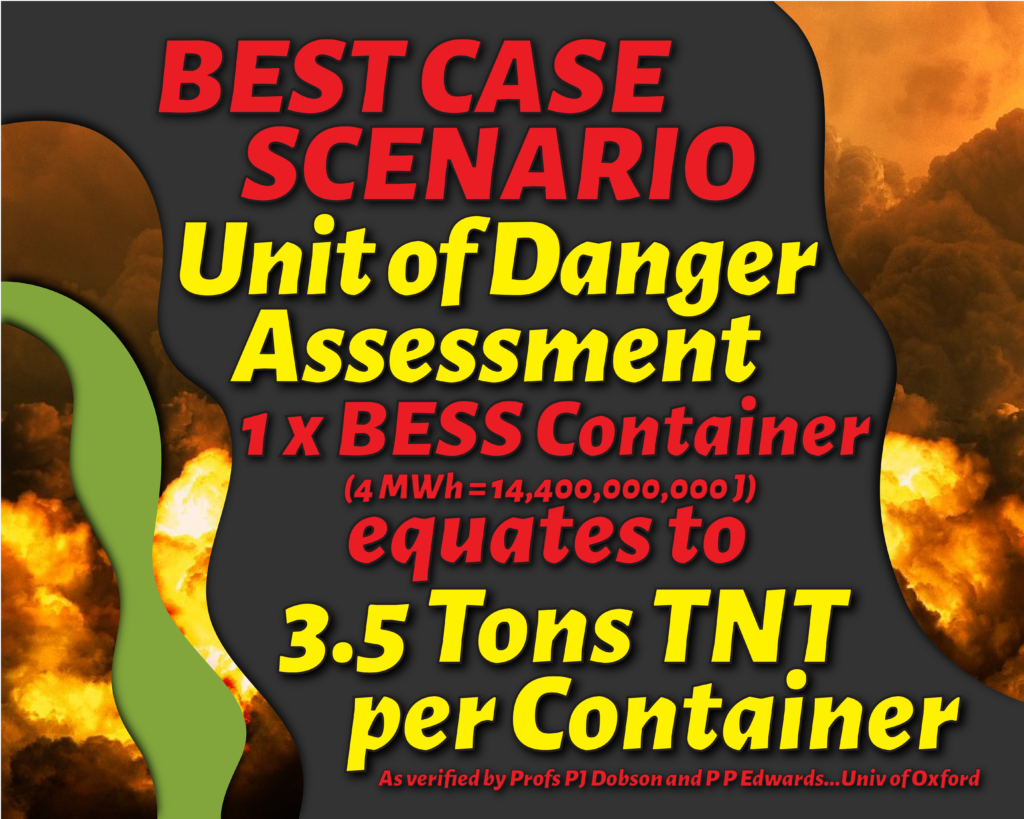
A single 4MWh BESS container harbors the explosive potential of 3.5 tons of TNT. Beyond the immediate blast, thermal runaway unleashes infernos, spewing toxic PFAS-laden smoke and chemical runoff that poisons soil and groundwater for generations.
Unit of Danger Assessment: Calculation based on a 4MWh BESS container. Each container equates to 3.5 Tons of TNT (Professors PJ Dobson and PP Edwards, University of Oxford). Note that many BESS installations have significantly larger MWh capacities, exponentially increasing the danger potential.
Uncontainable Infernos
BESS fires are notoriously difficult to extinguish, demanding thousands of liters of water and generating vast quantities of hazardous waste. The Liverpool BESS fire raged for an staggering 59 hours. Crucially, no UK statutory standards currently govern BESS siting or safety protocols.
Lasting Environmental Damage
The environmental fallout is severe. The Moss Landing contamination spread an alarming 20 miles. PFAS “forever chemicals” persist in the environment for decades, bioaccumulating through food chains and posing an irreversible threat to wildlife and human health.
Severe Health Impacts
BESS thermal runaway releases toxic gases including hydrogen fluoride, carbon monoxide, and other hazardous chemicals that pose serious respiratory and health risks to nearby communities. These toxic emissions can travel for miles and cause both acute and long-term health effects. Hydrogen fluoride concentrations can rapidly exceed the Immediately Dangerous to Life or Health (IDLH) level of 30 ppm, while carbon monoxide levels can reach thousands of ppm, far surpassing the short-term exposure limit of 200 ppm. These hazardous concentrations can persist over extended distances and time periods, posing a prolonged threat even after the initial event subsides.
A Critical Miscalculation
Storage infrastructure demands £300 million per GWh, yet the UK already possesses over three times the BESS capacity required to meet its 2030 targets. This over-investment squanders vital resources.